When I didn't receive this edition in the mail right away, I went to the Ploughshares website and signed up for three more years in subscription because I was so afraid I had run out of my old subscription. That was silly, I still had the rest of this year left, so no at least I know I'm locked in for four more years of this fantastic publication. If you're still not reading Ploughshares, perhaps you'll be lucky enough to find my old copy at the gym, in the work breakroom, at my kids reading center, or any of the other random places I leave these after I read them for people to find. This staff edited edition is full of poetry and short fiction which I read with relish, but it also contains the winners of the Ploughshares Emerging Writers contest and those entries did not disappoint. So as per usual, here are a few highlights:Poetry:Rob Arnold - What We Did Under the TreeYes, you can imagine, sometimes what they did was naughty. But when it comes in verse like:"Holding our breath, muddied and spentwhile tectonics shifted]imperceptibly under our feet, the late century sputtering onward"It's all quite lovely.Anders Carlson-Wee - Asking for Work at Flathead BibleI loved the storytelling quality of this poem and the sense of time as fluid but ever moving. Stuart Dybek - ModerationI love poems and stories that make me feel the passage of time, the lessons of growing up and growing older. This poem was one of those."Back then regret hadn't had time to grow. It arrived as suddenly"Daniel Lawless - The Dean Has No CommentA streaking girl at the zoo startles everyone it seems except the gorillas.Jo Sarzotti - Waiting for AchillesAre we brave in ourselves? Or are we waiting for a hero? Hilma Wolitzer - The SeparationAnother poem about siblings. I loved it. Non-Fiction:Roohi Choudhry - The Undertaker's HomeA writer living in Ireland at the historic home of a famous writer as part of a fellowship was brilliant. The narrator, of Pakistani descent, is drawn to the cliffs by the cottage and the stories they could tell on their own. His own past lingers like an extra character in the story. Beth Ann Fennelly - When Dusk Fell an Hour EarlierA woman who returns to the Czech Republic after a 20 year absence. Her earlier stint, as a ESL teacher in a far flung coal town was nothing like the study abroad stories of emerging cities and carefree spending in newly independent eastern Europe. She was in a coal town where the people had lived hard and knew nothing of excess or easy friendship. When she returns, she learns that her memories are colored by her own youth and inexperience and she learns a new appreciation for what she experienced. Farah Peterson - Illness and IdentityThis story also involved siblings, a brother and sister, and how the sister deals with her brother's mental illness. As the title suggests, it really digs into illness and how that shapes or informs identity, not only of ourselves, but how we see others who suffer from illness. Who decides the identity of a mentally ill person?Fiction:Tristan Hughes - Up HereThis story centered around the boyfriend of a park ranger, living mostly off the grid. At the beginning of the story, the ranger asks the boyfriend to shoot her dog, an old girl for whom even getting off the ground in the morning has become an extremely painful experience. There's a wisp of something more happening with the ranger in the background, but we don't really get to see it and the mood this lays over the story is supremely effective.Katie Knoll - IEDI love sibling stories. I'm currently listening to Cutting for Stone, which is about twins in Ethiopia and so this story fell right into that vibe I'm getting from Cutting for Stone. This one is from the sister's perspective. Her brother, the "love of my life" has been injured by an IED. And the story ticks back and forth from their childhood to the present. We're not entirely certain the extent of the devastation the IED has wrought to the brother, but I got the impression it was rather severe. The feeling in this story was so convincingly solid, I was certain this story was not fiction. Magogodi Oampela Makhene - The CaretakerThis story really delved into guilt and responsibility. It involved a rabid dog and an injured teen and people who have nothing and a slightly more than nothing. Josh Weil - The Essential Constituent of Modern Living StandardsI loved this one about a group of farmers who take on the power company in order to gain electricity for their rural area. I'd never thought about the setting up of the electric grid, and how prohibitively expensive it would have been to provide power over long distances to small populations. Finally, I should note that all three Emerging Writer selections were fantastic.Poetry - Leila Chatti - Confession As a Catholic, this view of Mary laboring, as a woman, not as a saint, was a wonderful look at a venerated person.Nonfiction - Mimi Dixon - BreathA daughter copes with the loss of her father, a famous oboist. The daughter works to finish her father's book while also dealing with her own medical issues. The story centered around the concept of breath and breathing, and it kept coming back to this concept in so many ways. Fiction - Lydia Martin - The Adjustment ActA Cuban immigrant deals with feelings of guilt and dissatisfaction as he works to bring his sisters and stepmother to America at any cost. I'm so thrilled to be exposed to so many great writers with every Ploughshares edition.
4/5 Stars.
 So many great things to say about The Boys in the Boat. This book has been on my "to-read" shelf for quite a while and I'm glad I finally came around to it as I really enjoyed it.The book tells the story of the 9-man crew who won gold at the 1936 Berlin Olympics. The story begins in 1933 with Joe Rantz arriving at the University of Washington's boat house in Seattle. He, and a hundred more freshmen are there to try out for the freshman crew team. At this point Joe has already overcome adversity in his life - being abandoned twice by his widowed and remarried father to LITERALLY fend for himself as a young teen. How this is possible is just completely beyond my sense of understanding people and I was deeply saddened for him.But Joe starts to find himself and trust in others through the task of rowing, and working with a team to win. Through Joe we are introduced to the other members of the crew, coxswain Bobby Moch, Roger Morris, Shorty Hunt, stroke Don Hume, Johnny White, Stub McMillan, Chuck Day, and Gordy Adams. How this group of men came to be together through coach Al Ulbrickson's tinkering is laid out well by the story. Brown provides excellent surrounding facts and circumstances to set the stage in which the men would row. The tactics of Hitler and Goebbels to have Germany appear as a legitimate civilized country amid the systematic oppression and eventual murder of jews, homosexuals, gypsies, catholics and political opponents, and the United States own troubles during the depression, including the crippling poverty experienced by several members of the crew.The story is beautifully and faithfully told. And having never rowed, I cared deeply about the men and really felt I understood the mechanics of rowing. And, despite knowing the outcome of the medal race, I found my heart rate increase when it came to the chapters detailing the races. I knew they would win, but I was worried for them because the odds did not look good. That they triumphed over so much was so lovely and uplifting. I wish I had met them.
5/5 Stars
There were a lot of things that just didn't work for me in Be Frank With Me. While the overall premise has promise, the pieces of the story didn't come together to make a pleasing narrative. Alice Whitley, an assistant at a publishing company, is sent to live in LA with eccentric novelist Mimi Gillespie. Mimi, writing under the pen name of M.M. Banning, wrote one critically acclaimed novel, married a movie star, divorced a movie star, had a son - Frank, and became a recluse in Los Angeles, talking to few people and never publishing another word. Sort of like a, if J.D. Salinger had only ever written Catcher in the Rye, and was a woman kind of vibe. Alice is called upon to help Mimi while she completes another book. Turns out that Mimi is now broke and needs the money so has promised to write another book for her publisher. Alice is sent to help with the transcription of the novel into type and to provide Mimi with whatever other assistance she needs in order to write the novel. This assistance is being a playmate to Mimi's ten year old son - Frank. Frank is eccentric. We know this because we are told over and over that he is eccentric, by the characters, by Alice. What we are shown is that Frank talks in a flat monotone, favors old movies, has a good memory for facts from old movies, and dresses in the fashion of said old movies. He is endlessly bullied at school by both the kids, and eventually by an overbearing principal. All the while, Mimi is presented as basically a horrible person. She loves Frank at least, but she's horrible to Alice. I can deal with an unlikeable character if it does something for the story, but here it doesn't. Mimi herself never talks much with Alice, and the only other two characters who know her, Xander, the handyman, and Mr. Vargus, the publisher, don't give much information about why they remain friends with Mimi aside from the fact that it appears Xander kind of feels sorry for her, and he has his own heap of issues as well.Alice flits naively from person to person in the story, and I didn't mind her that much until she becomes romantically involved with Xander, a vaguely described and poorly executed romance wherein both the characters' dialogue is eye-roll inducing. In the end, the story had no punch, and Frank, who while interesting and ultimately loveable, wasn't enough to carry the story over the rough patches.
2/5 Stars.
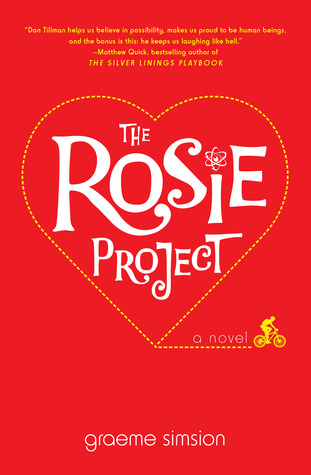
 This book was soooooo fun!! Don Tillman is a genetics professor in Melbourne, Australia. And well, he's a bit odd. He's probably on the autism spectrum, likely Aspergers, but he doesn't know it. So he has a very calculated way of speaking and evaluating people. He has two friends in the whole world, Gene and Claudia, a husband and wife who have an "open" marriage as Gene attempts to sleep with women from all nationalities. And somewhere in the beginning of the story, Don decides to solve his problem of being alone with "the wife project." Don creates a questionnaire to find himself the perfect wife. And in true Don fashion, as his life is ruled by a strict adherence to reason and rationality (to say nothing of the best use of time) he cannot deviate from the results his questionnaire is giving him.Sitting in his office one day, he is approached by a woman, Rosie, who has come to see him at Gene's insistence. Thinking she is a candidate for the wife project, Don asks her out on a date. But it's quickly apparent that Rosie has completely and utterly failed the questionnaire and is therefore, not a candidate for the wife project. Despite his adherence to rules, Don begins to seek out reasons to be with Rosie.I really enjoyed rooting for Don in this book. Although he was completely clueless and obtuse at times, I really wanted a good life for him. He was a good guy. Feel good and funny... this book was a real treat.
4.5/5 Stars.
This book had some issues, but all in all, it was kind of a fun look at art forgery and the world of struggling artists. Claire Roth is down on her luck. She's an artist, but some (slowly revealed) drama from her past has kept her from making it big in the cutthroat art world. She now divides her time between painting for herself, teaching an art class at a boys juvenile detention center, and copying masterworks for a company called Re-Pro, who then sells the oil painted copies for thousands of dollars. Enter Aiden Markel, the owner of an art gallery in Boston called Markel G. He has a proposition for Claire, he wants her to copy Edgar Degas' After the Bath V (there is no After the Bath V - it was created solely for the purpose of this novel) which was stolen in the infamous art heist from the Isabella Gardner Museum in the 1990s. During the heist, thieves dressed as cops stole 13 priceless works from the Museum, including Rembrandt's Storm on the Sea of Galilee. None of the paintings have ever been recovered. Having recently finished (and loved with every fiber of my reading body) The Goldfinch, I was prime for more art thievery. So Markel tells Claire that once the painting is copied, Aiden will sell the copy to an unsuspecting buyer who believes he's buying the real thing, and then will return the original to the museum. He also promises Claire he will give her a one-woman show at his gallery, and will pay her $50,000. Being desperately poor, Claire agrees. However, once she begins to study the painting, Claire begins to suspect that it's not a Degas at all - that the painting is a copy of the original. In the meantime, Claire and Aiden begin sleeping together and then... well... these two are the worst criminal masterminds every, so naturally their story begins to unravel.I'm not sure if the audio narrator just ruined Claire for me, but there were so many things I didn't like about Claire. First of all, everything she says is so dramatic and breathy (okay could be a narrator issue). Second, she's kind of an idiot. Her big secret from the past, is that when her more famous professor/boyfriend gets artist's block, she paints something for him to get him over his hump and then he enters it into a competition, which he wins. He receives fame and fortune based on the painting and breaks up with Claire. She's so distraught because of the "fraud" (hmmm suspect), that she urges him to come clean. When he doesn't, she tells the museum curator that she painted the famous painting. She's not believed, and then she's blackballed from the art world. So here, she's being asked to partake in a criminal conspiracy and inevitably she what? - Yeah she thinks everything is going to be okay by coming clean. Like I said, she's kind of dumb. And you know what? She is guilty of conspiracy to commit fraud, but somehow she doesn't see it that way. She thinks she can outsmart Museum directors, FBI agents and the press. I don't think it really works that way. Also, the "love" between Claire and Aiden I wasn't really buying either. I mean, I was okay with their sleeping together and what not, but Claire mentions several times she knows nothing about Aiden. I wasn't ready to jump on the "but then I fell in love with you" bandwagon. Lastly, there are these letters from Isabella Stewart Gardner to her niece Amelia which are meant to give the reader some added insight (you'll get the punchline of the book FAR FAR before Claire - remember she's a sweet dumb dumb), but they come off overly flowery and over the top. Anyway, this gets three stars because I was entertained, but there were some points where I had to shut off the recording and forget how much I was annoyed by Claire before turning it back on. The best parts were the sections about historical forgers and how technically art forgery is done.
3/5 stars.
 This review is all my fault. I saw All I did was Ask was $1.99 on the Kindle store and I bought it without thinking. I love Fresh Air. I love the interviews and the questions. I love Terry Gross. So I bought the book without looking at the description. What I was expecting - Terry's life story, kind of like Bossy Pants, but less funny (because - Tina Fey). With probably anecdotes of interviews or favorite excerpts. What the book is - excerpts. All excerpts, with maybe a couple lines detailing her own thoughts on the interaction. So, this review is my fault. I didn't realize what I was getting myself into. And I was disappointed. Because as much as I love listening to the interviews on the show, I don't really want to read them in a book. There's a lot of the flavor that is missing in just reading the interviews - things that make the audio so compelling. So I had high hopes for this book that were partly my own fault for not reading the description better, and then partly because these interviews are meant for radio and they're presented here in text, and something about it just doesn't work.
2.5/5 Stars.
 I received this book from NetGalley in exchange for an honest review. After I opened up the book and read the first few lines, I was wondering what I'd gotten myself into. I went back and read the Goodreads description. Medea, from Jason and the Argonauts, retold in prose, from Medea's perspective. I was familiar with the story of Jason and the Argonauts, in as much as I had heard their names, and knew it involved the recovery of a golden fleece, but that was it. I asked my husband, "What do you know about Jason and the Argonauts?" His reply, "Is it a band?" So after about 15 minutes on Wikipedia, I felt backgrounded enough to start in on this story. The prose writing feels like a hat tip to Greek epics, and indeed, Jason and his Argonauts had plenty of adventures in recovering the Golden Fleece, but Bright Air Black starts off with Medea on the bow of the Argo, hacking her brother to pieces in and tossing him into the sea in order to slow her father's pursuit. And for what? A fleece covered in gold only because it was used to sift for gold in a stream in Medea's kingdom. As the Argo speeds toward Iolcus, Jason's home, the gold dust slowly shakes out of the fleece, and the entire Jason and the Argonaut myth unravels for us, and for Medea as well.Expected to arrive in Iolcus as a hero, and granted the throne his birthright demands, Jason instead finds his uncle Pelias enthroned as king, Jason's own father, brother and mother, all killed by Pelias in brutal fashion. Jason and Medea are enslaved. Over the course of six years they have two sons together while Medea plots revenge on Pelias that would give Jason his kingdom back. But things never go quite as Medea thinks they will. Yes, the people are afraid of her, as she wanted, but that doesn't always give her the result she expects. And she has this awareness of things, of knowing that the stories which are ultimately told will not match the truth of events. I can see why ancient Greeks were so intrigued by her. A princess who commits horrendous acts in the name of love, for Jason, for her sons. But who sacrifices all those things she claims to love in the name of revenge. She's a deft with a blade as with poison, as with trickery. Does she really even love Jason? Does she really have any power at all? Medea is such a rich character that of course Euripides would make an entire Greek tragedy of her later years. David Vann's retelling is remarkable all the more for giving us yet another view of Medea. She's altogether ancient and modern. This book was a real pleasure.
4/5 Stars.
 When I didn't receive this edition in the mail right away, I went to the Ploughshares website and signed up for three more years in subscription because I was so afraid I had run out of my old subscription. That was silly, I still had the rest of this year left, so no at least I know I'm locked in for four more years of this fantastic publication. If you're still not reading Ploughshares, perhaps you'll be lucky enough to find my old copy at the gym, in the work breakroom, at my kids reading center, or any of the other random places I leave these after I read them for people to find.